
Solutions & Applications
REPAIR OF SURFACE CRACKS IN RENDERS/PLASTERS
Appearance of surface cracks in render/plaster mortars with a width and depth less than 10mm (<10mm). Non-dynamic cracks.
Causes
The most common reasons for appearance:
- Premature curing/setting of the render/plaster mortars
- Intense dehydration of the render/plaster mortar (e.g., due to very high temperature, strong air currents, etc.)
- Insufficient mixing and preparation of the render/plaster mortar
- Wrong mixing water ratio
- Micromovements of substrates (a particularly common phenomenon in areas where different types of building materials meet, e.g., concrete with brick, concrete with dry construction/drywall, thermal insulation boards with brick or concrete, etc.)
- Particularly increased application thicknesses
- Settlement of the building structure
- Thermal shocks, due to intense temperature fluctuations, etc.
- Seismic activity
Additional Bibliographical Reference:
Technical Chamber of Greece https://portal.tee.gr/portal/page/portal/MATERIAL_GUIDES/P_KONIAMATA/ko3.1.htm
Problem Rectification
- The area around the crack must be cleaned of dust, dirt, grease, oils, loose materials, and foreign matter.
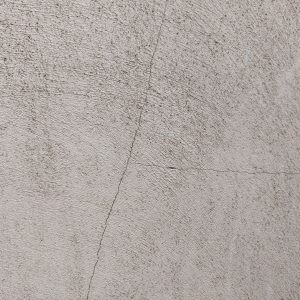
- Using a chisel or a sharp tool, the crack is slightly opened (at a 45° angle, width of at least 3mm, and depth up to approximately 1cm).
- The opened crack is cleaned, and dust is thoroughly removed, e.g., with a brush or compressed air.
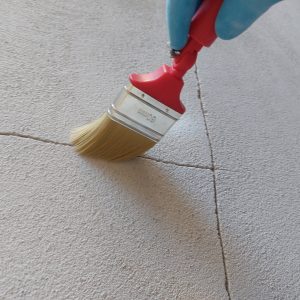
- It is recommended to prime locally in the repair area, using a suitably diluted substrate stabilization primer (water-based or solvent-based). Caution! The dilution must be such that the primer is properly absorbed and does not form a film on the surface. Allow the material to dry thoroughly.
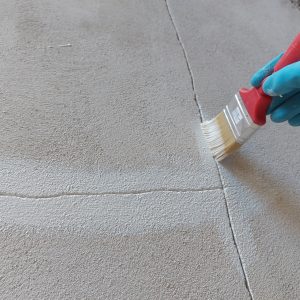
- A crack and joint filling and sealing material is used locally in the repair areas. The use of an elastomeric putty/filler, characterized by low shrinkage, high adhesion, and alkali resistance, is recommended. Application is done with a metallic spatula in one or more layers, depending on the application thickness. The second layer follows after the first one has dried sufficiently. Note: In cases of severe and/or long cracks, the embedding of a suitable reinforcement mesh or gauze, extending approximately 10cm on either side of the cracks, is recommended.
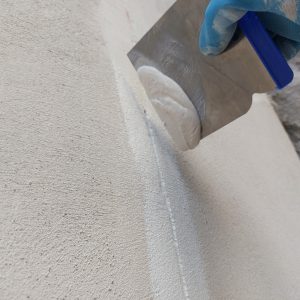
- Once the material has dried, if necessary, the surface is sanded appropriately for a uniform finish.
- The finishing work for the desired final surface follows, where required.
Notes:
1. Strictly follow the Instructions for Use & Precautions listed in the corresponding Technical Data Sheets or packaging of the repair materials.
- 2. In case of capillary cracking (thickness $< 0.3 \text{mm}$), the above repair procedure is not required. The use of suitable trowel fillers/putties or elastomeric paints/coatings is recommended.

 Ελληνικά
  English